Physical Address
304 North Cardinal St.
Dorchester Center, MA 02124
Physical Address
304 North Cardinal St.
Dorchester Center, MA 02124

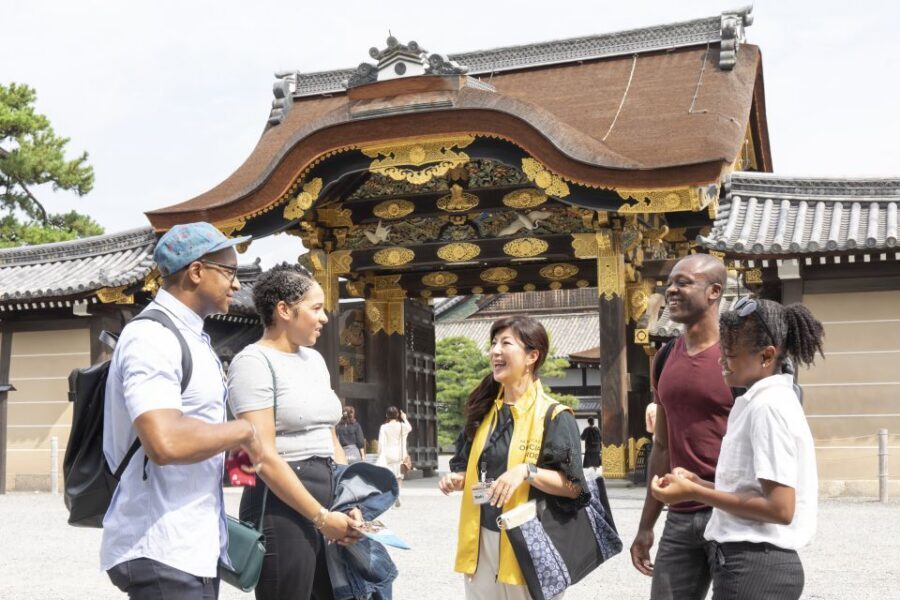
Explore Nijo Castle’s shogun’s palace, gardens, and restricted areas with an English-speaking guide. One hour, with admission paid separately.
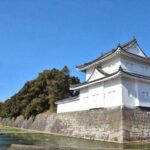
Nijo Castle is less a battlefield fortress than a stage for power. Built in 1603 as Tokugawa Ieyasu’s Kyoto residence, it later became an imperial palace; today, its Ninomaru Palace still gives you a rare look at the rooms where the shogun worked and received visitors. This one-hour guided tour links the architecture to the political drama that played out inside it.
I like two things in particular: a guide helps make the palace’s artwork and room layout legible, and the tour may include access to areas closed to ordinary visitors. Guides such as Miki, Ai, Kaoru, and Don have led tours here, explaining everything from shogun-era customs to the symbolism in the paintings.
The main catch is the extra cost: the $16 tour price does not include castle admission, which you must pay in cash on site. One hour is also a brisk introduction, not a full visit to the extensive grounds.
Nijo Castle was built in 1603 for Tokugawa Ieyasu, the first shogun of the Edo Period. Its setting in Kyoto mattered: this was the city of the emperor, while the shogun held the country’s political and military power. The castle was a residence and a working seat of authority, not simply a fortified stronghold.
That distinction changes how you read the place. You are not just looking at defensive walls and gates; inside Ninomaru Palace, you are following the spaces where the shogun received people and conducted business during visits to Kyoto. A guide can connect the rooms to the relationships and power plays behind them, giving meaning to a building that might otherwise seem like a sequence of beautiful interiors.
After the Tokugawa Shogunate fell in 1867, the castle served as an imperial palace. It was later donated to Kyoto City and opened to the public as a historic site. Nijo Castle became a UNESCO World Heritage Site in 1994, recognition of its cultural importance and of the exceptional survival of its feudal-era buildings.
If you prefer having a local expert, these guided Kyoto experiences could work well
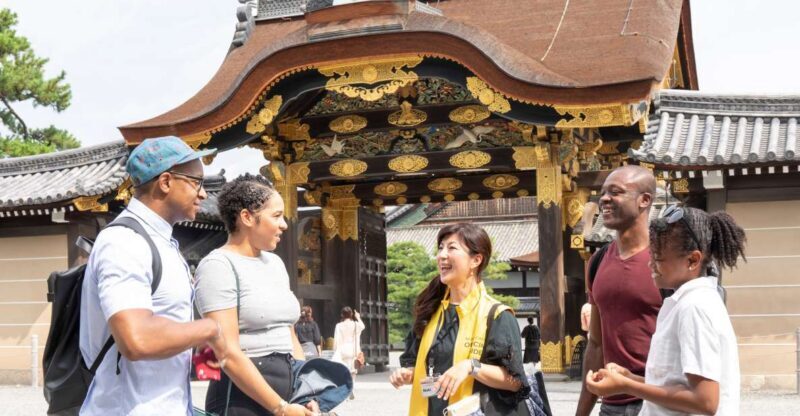
The meeting point is the ticket booth reception area just inside the East Main Gate, also called Higashi Ote-mon. Enter through that gate and look for the reception area beside the General Reception, on the left. The directions are specific for a reason: arriving at the wrong entrance or wandering around the grounds can make you late.
Be there well before the start time. The tour does not wait for late arrivals, and you cannot join once it has begun. Check the meeting instructions in your booking confirmation before setting off, and allow time to find the correct gate.
The first part of the walk helps orient you within the castle. Nijo Castle is divided into the Honmaru, or main defensive circle; the Ninomaru, the secondary circle; and the gardens surrounding both. The tour focuses on the Ninomaru side, where the palace and its approach offer the clearest picture of the castle’s ceremonial and political role.
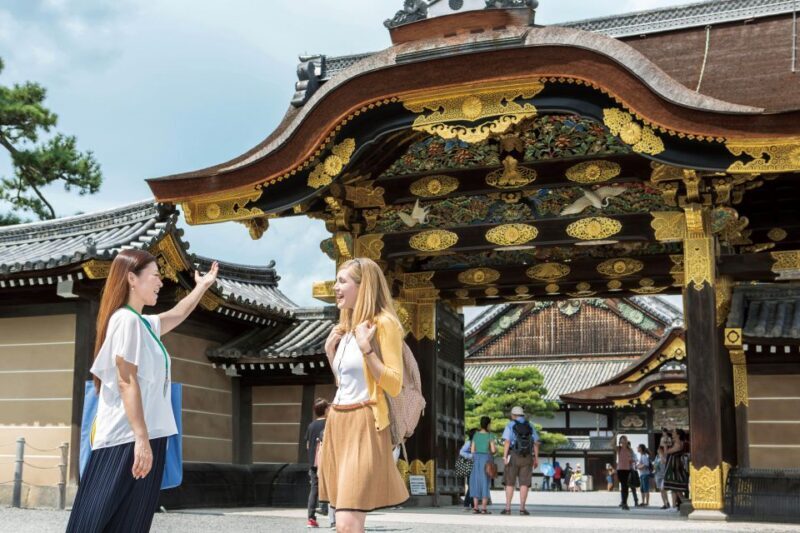
Kara-mon Gate marks the entrance to the Ninomaru and sets the tone for the palace beyond. Its elaborate appearance contrasts with the practical purpose of a defensive complex. A guide can point out details in the gate and explain how architectural decoration carried messages about status and authority.
The gate is a useful pause before entering the palace. Rather than treating it as a quick photo stop, listen for how the guide relates its design to the shogun’s position and to the formal movement of people through the grounds. That context helps you see the castle as a carefully arranged public statement, not just a collection of old buildings.
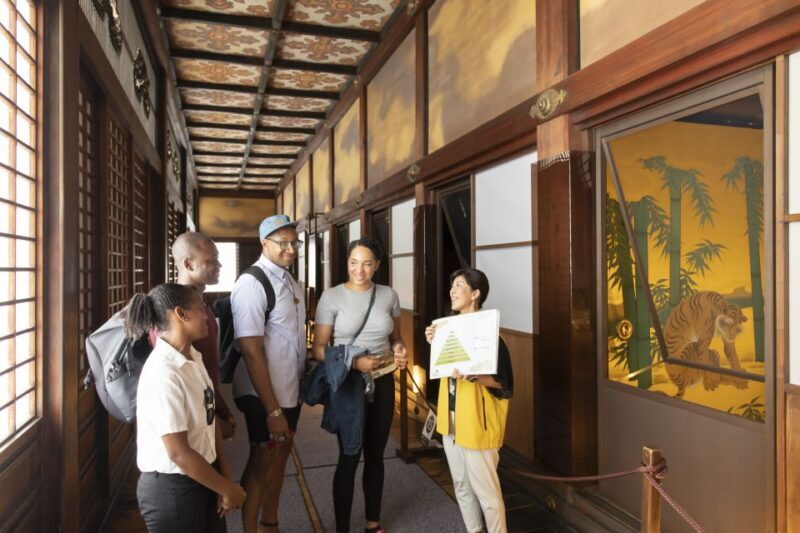
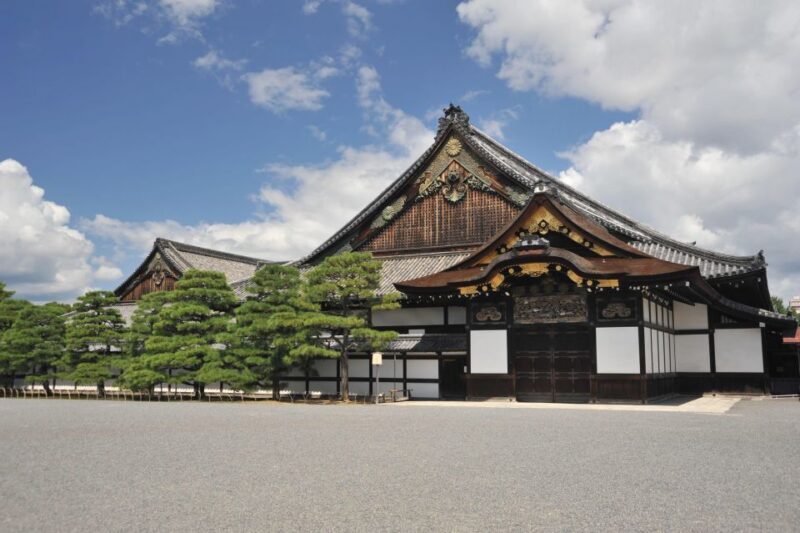
Ninomaru Palace is the heart of the visit. It served as the shogun’s residence and office in Kyoto, and it remains intact. The guided route takes you through the palace’s rooms, where the guide explains their functions and the way the interior’s art and decoration relate to court life and political authority.
Without explanation, room after room can blur together. A guide such as Ai, Miki, Kaoru, or Don may help you picture who used a particular room, what kind of meeting took place there, and how the arrangement of the space reflected rank. The best explanations connect small details to larger themes: the shogun’s authority, relations with the emperor, and the customs of samurai society.
The paintings and carvings are part of that story. Guides draw attention to symbolism and decorative details that are easy to miss when you are moving with the flow of people. Some explanations also connect the palace’s designs to familiar modern images and characters, offering an unexpected bridge between traditional art and present-day popular culture.
The palace can be busy, and the route moves through interior spaces where you may be walking with other groups. A calm, clear guide matters here. The English-language guides are often praised for speaking clearly, keeping groups together, and making time for questions. If a particular historical detail interests you, ask while you have the guide’s attention.
There are practical limits inside. A visitor has noted that the palace has no air conditioning and that water and photography are not allowed inside. Treat those as important planning points, especially during hot weather: drink water before entering, and don’t expect to take interior photos. The palace’s quiet, carefully preserved rooms are best appreciated at a measured pace.
More Great Tours NearbyOne distinctive reason to book the guided tour is the possibility of entering areas that are normally closed to the public. Some participants have described seeing additional sections connected to the shogun’s private quarters. That access can add a sense of discovery, as well as a closer look at features you would not encounter on an independent walk.
Access can depend on the specific tour, so don’t book on the assumption that every departure will include the same restricted spaces. The reliably useful part is the guide’s interpretation of the rooms and grounds; any extra access is a bonus. If this feature is central to your decision, check the current tour details when booking.
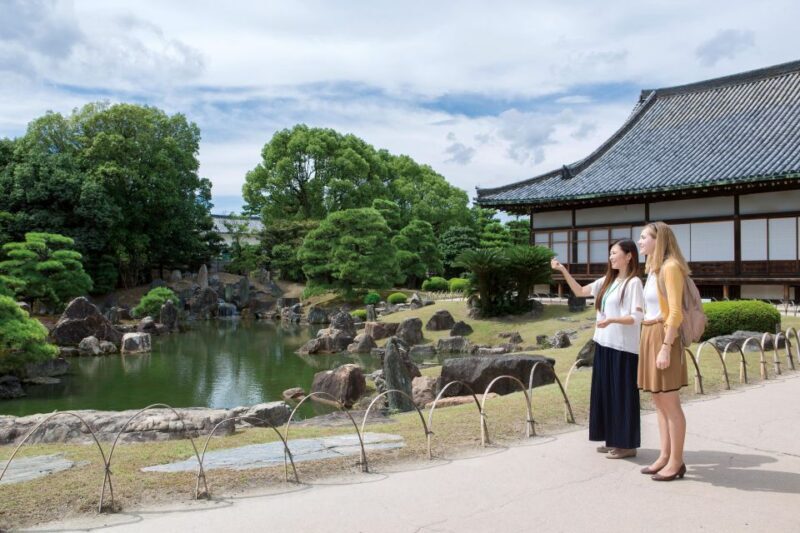
The route includes Ninomaru Garden, one of the green spaces within the castle grounds. After the palace’s indoor rooms, the garden offers a change of pace and room to take in the layout of the Ninomaru. Your guide can point out its place in the wider castle complex before the tour ends.
A one-hour tour cannot cover every corner of the grounds in depth. That is not necessarily a problem: the guided walk gives you a framework, then you can linger in the garden or explore more of the site independently. Several visitors have found this division works well, with the guide providing the history and the remaining time left open for personal wandering.
The broader grounds include the Honmaru as well as the Ninomaru and their surrounding gardens. The guided route listed here covers the main gate, Kara-mon Gate, Ninomaru Palace, and Ninomaru Garden, so check the site map if you want to plan more time beyond the tour. The castle visit need not end when the guide signs off.
At $16 per person, this is a relatively inexpensive way to add historical context to a major Kyoto site. You are paying for a 60-minute English-language guided tour, not for entry to the castle. The admission fee is separate and must be paid in cash at the site; one visitor account put it at 1,300 yen, but confirm the current fee before you go.
The guide is the main value. You can walk through the castle on your own, but the palace’s symbolism, room uses, and political significance are not always self-evident. If you enjoy history and want more than a look at the architecture, paying for an explanation can make the visit much more rewarding.
Think of the tour as a focused introduction, not a complete castle day. It lasts one hour, and transport is not included. If you are already planning to visit, the extra spend is easier to justify than it would be for someone with little interest in Japanese history or architecture.
The tour is conducted in English, and the booking page provides available starting times. It includes the guide, but not transportation or castle admission. The admission fee is payable in cash on site, so bring enough rather than expecting to pay for it as part of the tour booking.
Each paid participant may bring one child aged 0 to 12 for free. The child must stay with an accompanying adult, and earphones are provided only to paid participants. If a child needs earphones, or if you want to bring more than one child per paid adult, the additional child must have an adult ticket.
Ninomaru Palace closes on Tuesdays in July, August, December, and January, as well as from December 26 through January 3. Check the date carefully before booking, especially for a winter or midsummer visit. The tour cannot go ahead as planned when the palace is closed.
The tour offers free cancellation up to 24 hours in advance for a full refund. That is useful if your Kyoto plans are still shifting, but it does not change the need to arrive on time once you have kept your booking.
I would choose this tour if you want the castle to make sense as a place of government, not just a beautiful historic site. It suits first-time visitors to Nijo Castle, history-minded visitors, and anyone curious about how shoguns used architecture, art, and formal rooms to express power. The guide-led format is especially helpful if you want to ask questions or understand details you might otherwise walk past.
It is also a good fit if you value a short, structured introduction and would rather explore the gardens at your own pace afterward. Families can bring one child aged 0 to 12 free with each paid participant, though the child must stay with an adult and will not receive an earphone unless booked as a paid participant.
I would skip it if you want a long, self-directed visit with no schedule, or if you are not comfortable paying the entry fee separately in cash. For most curious visitors, though, the guide’s explanations are the point: the palace becomes easier to read, and the castle’s political history comes into focus. Just budget for admission, arrive early at the East Main Gate, and bring water for the walk outside.
“Fantastic tour. Super informative and friendly guide. Important historical context added to the experience so I highly recommend getting a guide fr…”
The tour lasts 60 minutes.
The tour is conducted only in English.
No. Castle admission is not included and must be paid in cash on site.
Enter through the East Main Gate and gather at the reception area beside the General Reception, on the left after you enter. The booking confirmation provides further details.
The guided tour includes Higashi Ote-mon Gate, Kara-mon Gate, Ninomaru Palace, and Ninomaru Garden.
Each paid participant may bring one child aged 0 to 12 for free. The child must be accompanied by an adult. Earphones are provided only to paid participants.
It is closed on Tuesdays in July, August, December, and January, and from December 26 through January 3.
You can check availability for your dates here: