Physical Address
304 North Cardinal St.
Dorchester Center, MA 02124
Physical Address
304 North Cardinal St.
Dorchester Center, MA 02124


Walk Kibera with guides who live there, visit a family home and community center, and support local programs through a three-hour tour.
Kibera is not a neighborhood you can understand from a passing car window. This three-hour walk takes you inside with guides who were born, raised, and still live there, including Benta, Erick, Samuel, and Jack. Expect a guided introduction to daily life, not a view from a distance.
I like two things in particular: the home visit, which makes practical details such as water, electricity, and bathroom arrangements easier to understand, and the community benefit. The $15 fee goes back to Kibera through KCOOP Organization, which runs programs in education, food support, arts and sports, economic empowerment, and environmental conservation.
One thing to consider: the visit can be emotionally difficult. You will see living conditions that may be far from your own, and this is a residential community, not a display. Go with curiosity, listen carefully, and ask before taking photographs.


The meeting point is in front of the Java House coffee shop inside Prestige Plaza Shopping Mall on Ngong Road. From there, the group travels by car to the guides’ office in Kibera. Be sure to identify the right Java House and arrive with enough time to meet your guide before departure.
The tour lasts about three hours, with roughly two and a half hours listed for the Kibera visit itself. The pace and length can be adjusted to your interests, and the guides can customize the route. You finish at Kibera Town Centre, so do not assume you will return to Prestige Plaza at the end.
The office is a useful first stop rather than a formality. Your guides give a short briefing, and the space has free Wi-Fi and clean washrooms. That is a practical comfort before the walk, as well as a chance to hear how the tour will work and ask questions.
Looking for more options in Nairobi? Here are some other experiences worth considering.
A panoramic viewpoint helps you get your bearings before walking through the neighborhood. From above, you can begin to understand Kibera’s scale and layout, then connect the broad view to the homes, streets, and community spaces you visit on foot.
This is a photo stop, but it is worth taking a moment to listen before reaching for your camera. Kibera is home to people going about their day. Ask your guide about suitable photo opportunities, and seek permission before photographing residents, especially children.

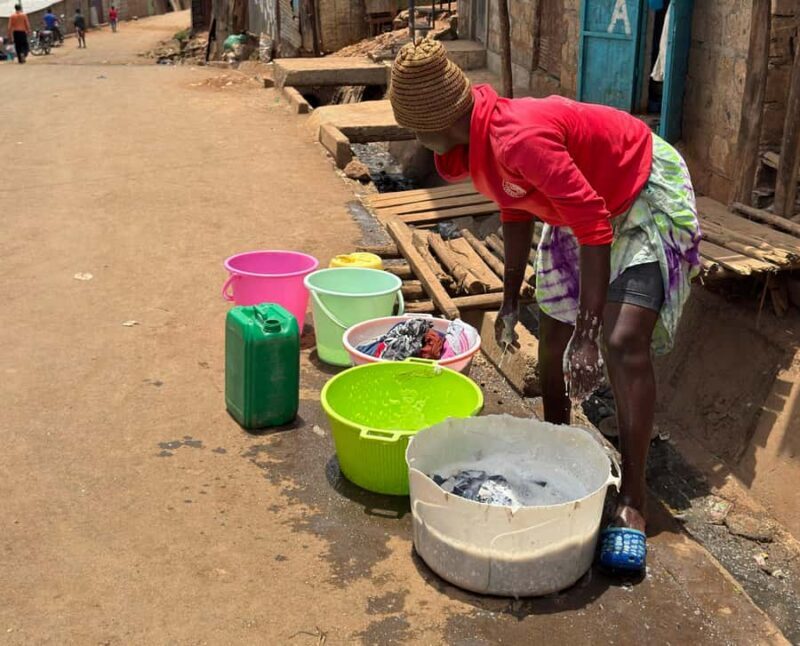
The home visit is the tour’s central stop. A resident welcomes you inside a local home, where your guide can explain practical parts of daily life: how people get water and electricity, how the bathroom system works, and how much space a typical home provides.
Those details matter. A broad statement about poverty can leave you with little understanding of how people manage ordinary routines. Seeing a home, with permission from the person who lives there, gives you a more grounded sense of the conditions and choices involved.
It can also be the most confronting part of the walk. Keep questions respectful and listen to the answers without treating the home as a spectacle. Your guide can help you understand what you are seeing, but a short visit is only one household’s experience, not a complete picture of Kibera.
At the Kibera Handicrafts Centre, local makers turn recycled and reused materials into jewelry and other handmade items. It is a different kind of stop from the home visit: instead of focusing on household needs, you see skill, work, and resourcefulness in practice.
The center also gives you a way to support local makers directly. If you are interested in a piece, take time to look at what has been made and ask about the materials or process. Buying is optional; the point is to see a side of the community that can be missed if a visit focuses only on hardship.
More Great Tours Nearby
KCOOP Organization was founded and registered in 2022. It works in Kibera and rural parts of Kenya, with programs in education, combating child hunger, arts and sports, economic empowerment, and environmental conservation. The tour includes a visit to its community center, which serves people in need.
For many people, this stop makes the tour’s community-support element more tangible. Rather than paying only for a guided walk, your booking fee contributes to an organization with ongoing programs. The supplied information does not specify the exact amount or percentage from each booking, so treat the contribution as support for KCOOP’s work rather than a guaranteed donation of a particular sum.
Some tours include time with children at a child-friendly space or center, but the exact activities may vary. If you are hoping to learn about KCOOP’s programs, ask your guide what is happening that day. A short visit can introduce the work, but it is not a substitute for a fuller understanding of the organization.

The final souvenir stop offers handmade African crafts and items produced locally. Prices are marked, fixed, and transparent, so there is no need to bargain or guess whether a first price is inflated. That makes the shop a straightforward place to buy something while keeping the transaction local.
You can bring cash if you might want to purchase a souvenir. Buying something is entirely optional, and the tour’s community support does not depend on making an extra purchase. If you do shop, ask which items are made in the area and choose something you genuinely want, rather than buying out of obligation.

The organizers say you may bring items such as school supplies, snacks, used clothes, sports or art materials, hygiene products, or basic food supplies. This is optional. You do not need to arrive with gifts to take part or to show respect.
If you want to contribute, shared supplies for a center may be easier to distribute fairly than individual treats for children along the route. Ask your guide what is useful and how to hand it over. A group can include around 50 children at a children’s center, with others nearby, so bringing a small number of gifts can put staff in the awkward position of deciding who receives them. Do not promise or hand out items before checking with your guide.
The same care applies to interactions. Children may greet you warmly, but they are not part of the tour’s scenery. Keep the encounter human: say hello, follow your guide’s lead, and do not photograph anyone without permission.
At $15 per person, the price is modest for a three-hour guided experience that includes a car transfer from the meeting point to the first stop, a local guide, several stops, and support for KCOOP’s community programs. The most important value is not the number of places covered. It is having someone from Kibera explain the area and answer questions as you walk.
Meals and drinks are not included. Bring water, sunscreen, and comfortable shoes; hand sanitizer or tissues are also recommended. The route involves walking through the neighborhood, and the experience is not suitable for wheelchair users.
Booking offers free cancellation up to 24 hours in advance, and a reserve-now, pay-later option is available. Starting times depend on availability. The tour is conducted in English.

This experience suits you if you want to understand more of Nairobi than its city center and are willing to approach a sensitive subject with care. It is also a good fit if you value community-led interpretation and want your fee to support local work. The guides’ personal ties to Kibera are central: they can give context, answer questions, and help you move through the area with more confidence.
It may be less suitable if you are uncomfortable visiting residential areas or expect a light, purely scenic outing. The visit can be sobering, and the conditions you see may stay with you. Families can take part, but parents should consider how their children might respond to the material and the home visit.
The tour’s strongest quality is its local perspective. People who live in Kibera lead it, and the planned stops balance an overview of the area with a personal home visit, local craft, and KCOOP’s work. Keep your expectations realistic: three hours offers a useful introduction, not a full account of a large community.
Book this tour if you want a guided, community-led introduction to Kibera and are ready to listen as much as you look. The combination of a home visit, local guides, handmade work, and KCOOP’s community center makes the experience more substantial than a quick pass through the neighborhood. Go respectfully, bring practical questions, and treat any gifts as optional. If you want only a comfortable sightseeing stop, choose something else.
“Benter was an inspirational young lady from the Kibera and was our exceptional guide. She lives in Kibera and knows everyone. She was really able t…”
Meet in front of Java House inside Prestige Plaza Shopping Mall on Ngong Road.
The tour lasts about three hours. The organizers can make it shorter or longer to match your interests.
The live guide speaks English.
After meeting at Prestige Plaza, you travel by car to the guides’ office in Kibera.
The tour finishes at Kibera Town Centre.
An expert guide is included. Meals and drinks are not included.
Wear comfortable shoes and bring sunscreen, water, and hand sanitizer or tissues.
No. Bringing items such as school supplies, snacks, clothes, or hygiene products is optional. Ask your guide what would be useful and how to distribute it.
No. The tour is not suitable for wheelchair users.
You can check availability for your dates here: