Physical Address
304 North Cardinal St.
Dorchester Center, MA 02124
Physical Address
304 North Cardinal St.
Dorchester Center, MA 02124

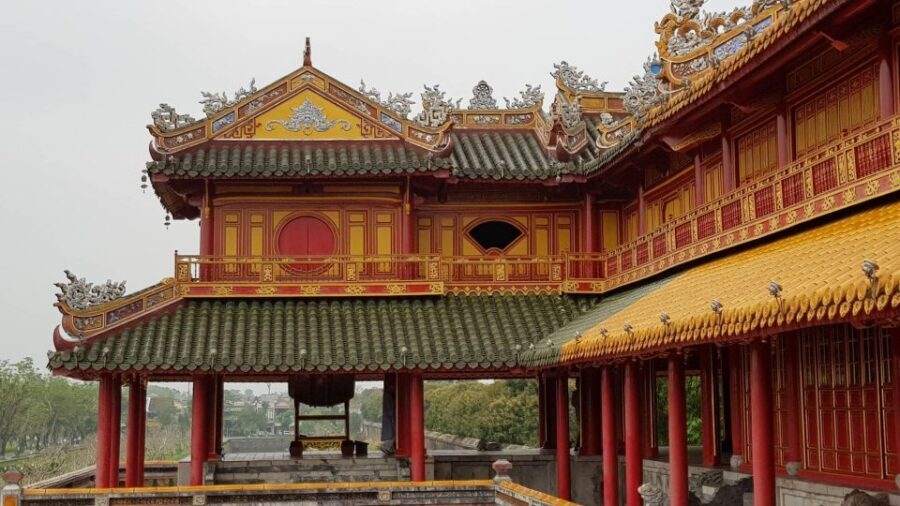
Choose a guided walk through Hue’s Imperial City or a private car to royal tombs, with flexible plans, local insight and entrance fees to budget for.
Hue’s Imperial City is more than a procession of gates and palace halls. A good guide can connect its carved symbols and royal spaces to the lives of Nguyen emperors, their wives, concubines and eunuchs, giving the citadel a human story as well as an impressive scale.
I like two things about this experience: the walking tour is a manageable way to make sense of the main royal buildings, and the private-car option lets you choose other major Hue sights at your own pace. Guides such as Misa, Ha, Nhien and Duy have earned praise for clear explanations, warmth and a willingness to answer questions.
The main catch is that the advertised price of $12 does not include admission. The walking tour also starts at the citadel rather than picking you up, while the car option includes a driver, not a licensed guide. Choose carefully, since these are quite different ways to see Hue.
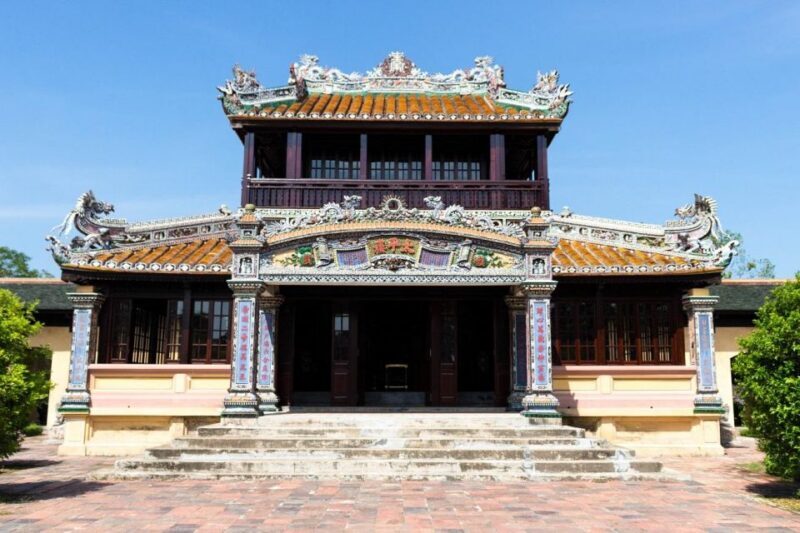
The walking tour is the clearest fit if you want context inside the citadel. In about two and a half hours, you visit the main ceremonial and royal areas with a local English-speaking guide. You can ask about architecture, court customs and the Nguyen rulers as you go, rather than trying to piece the story together from signs and buildings on your own.
The private-car trip solves a different problem: Hue’s sights are spread out. You can plan a route that may include the Imperial City, Thien Mu Pagoda, and the tombs of Minh Mang, Tu Duc and Khai Dinh, or the abandoned Thuy Tien Water Park. The exact selection and duration depend on the option you book, with trips running from around 150 minutes up to eight hours.
That distinction matters. A private car does not mean a private guided tour of every site. The driver speaks English for communication, but is not described as a licensed guide. If historical explanations are your priority, book the walking option. If you want transport between several places and are happy to explore some stops independently, the car may suit you better.
You can check availability for your dates here:
For the walking tour, meet near the four bronze cannons at Ngan Gate, also called Cua Ngan. The guide holds an A4 paper with your name. Check that you are on the correct side: five cannons sit opposite the four used as the meeting landmark.
The Nine Holy Cannons are an apt introduction to Hue’s royal scale and craft. Cast by Hue artisans in 1803, they are prized as bronze works of art. They once stood near Ngo Mon Gate and were later moved to their current position during the reign of Khai Dinh. Your guide can help explain why these objects mattered beyond their size and decoration.
There is no hotel pickup with the small-group walking tour, so allow time to reach the meeting point. The private-car option is different: pickup is offered at city-centre hotels in Hue or Hoi An, Hue Railway Station and Phu Bai Airport. Locations outside the stated city-centre areas may cost extra, so confirm your address before setting off.
Looking to discover more of Hue Vietnam? Consider these other city tour options
The Flag Tower, or Ky Dai, stands at the centre of the citadel’s southern side. It was the royal court’s flag site, and its position helps you understand the citadel as a planned complex rather than a collection of isolated monuments. The stop is brief, around five minutes, so treat it as a quick orientation point rather than a long visit.
Next comes Ngo Mon, the Noon Gate. Built in 1833 under Emperor Minh Mang, this was used for troop movements and ceremonies. It is one of the most recognizable entrances to the Imperial City, but a guide adds meaning to the formal setting: this was a working threshold for royal authority, not simply a photogenic arch.
The route gives you time for pictures and a look around, though the listed stop times are short. If you are keen to linger over details, ask your guide how much time the group can spare. The tour’s strength is a steady route through many connected places, not an unhurried visit to every corner.
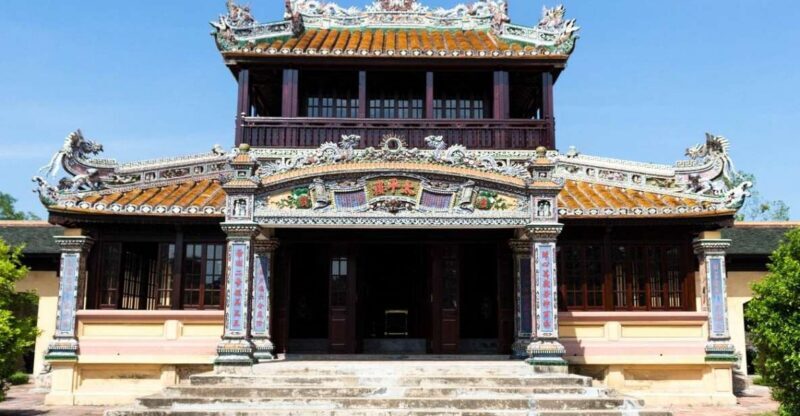
Thai Hoa Palace, also called the Palace of Supreme Harmony, was the coronation site for 13 Nguyen kings, from Gia Long to Bao Dai. In the royal system, it was regarded as the country’s centre. Even without knowing every ruler’s name, you can appreciate the purpose of the grand hall: ceremony made power visible.
This is one of the stops where a guide’s storytelling earns its keep. The building’s importance is not just its appearance. It gives you a point of reference for understanding the court hierarchy and the rituals that shaped royal life. Guides including Misa and Ha have been praised for explaining history in accessible terms, while Misa has also been noted for drawing attention to architecture and symbolic details.
The itinerary allots about 15 minutes here, so expect an introduction rather than a long lecture. The pace is a good fit for visitors who want a broad account of the citadel without spending a full day inside it.
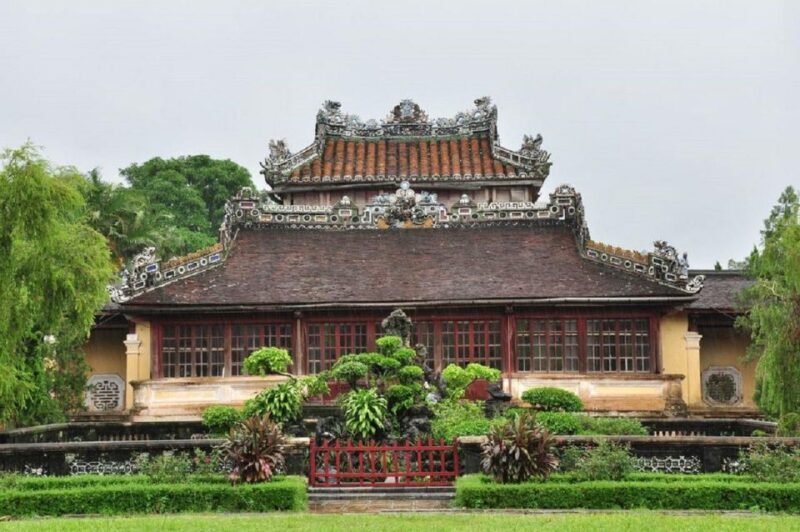
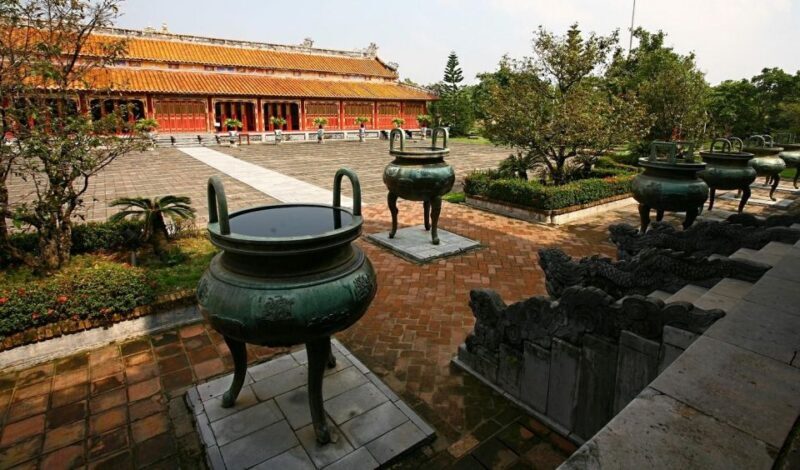
From the palace, the walking route visits Hien Lam Pavilion, the Nine Dynastic Urns and several temples. The nine bronze urns were commissioned by Minh Mang in 1835 and inaugurated in 1837. Set in front of The Mieu Temple, they connect imperial rule with the memory of the dynasty.
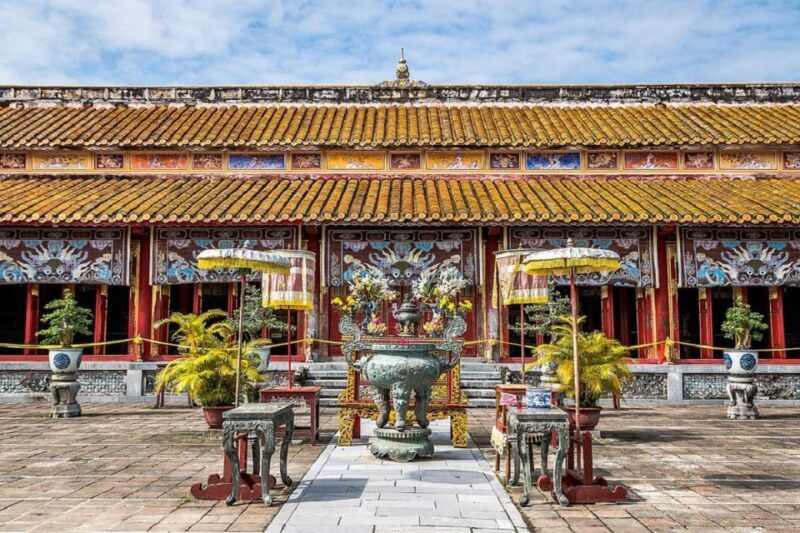
The Mieu, also called The To Mieu, was built in 1821 by Minh Mang and is dedicated to ten Nguyen kings. Nearby, the route also names Hung To Mieu and Hung Mieu. These temple stops can blur together if you are moving quickly, but their presence helps show how the court honoured ancestors and maintained its own history.
The tour’s short scheduled stops here are mostly five to 15 minutes. That is enough to get the essentials from your guide and see the main features, but not necessarily enough for a slow photographic study. I would keep a little independent time after the tour if temples and royal memorials are a particular interest.
More Great Tours Nearby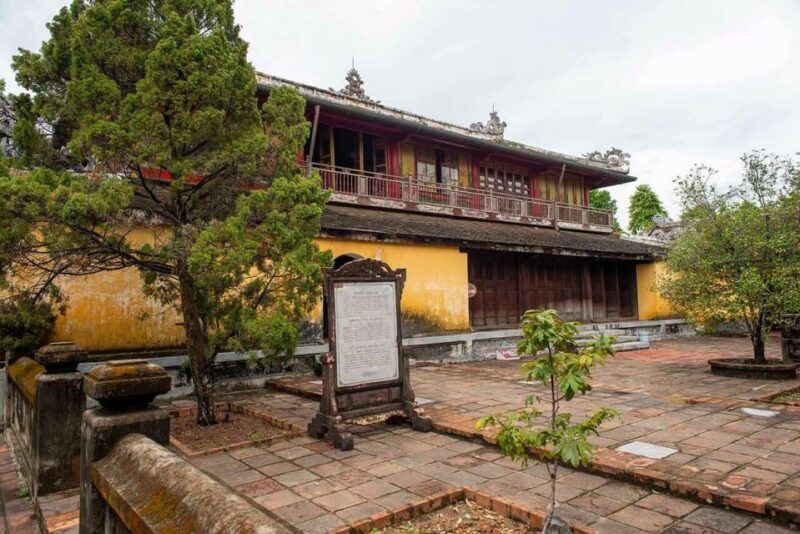
Behind Thai Hoa Palace lies the Forbidden Purple City, once the centre of the emperor’s daily life. Gia Long began building it in 1804; Minh Mang renamed it in 1822. Its restricted world belonged to the emperor and the royal household, including queens, lesser wives and concubines. The tour also opens a window onto the roles of eunuchs within the court.
This is where the royal story becomes less abstract. Ceremonial halls show how the dynasty presented itself; the Forbidden Purple City points toward private life and the people who lived and worked within the palace system. You will not see every part of the original complex intact, and the citadel has suffered damage. One useful perspective to bring is that some of what you see is comparatively recent in relation to the dynasty, rather than a perfectly preserved royal world.
The walking tour spends about two hours in the Imperial City overall, with the Forbidden Purple City among its central sections. Guides have been praised for explaining symbolism in numbers and animals, as well as the connections visitors may notice between Confucianism, Feng Shui and Buddhism. Ask questions. This is the part of the visit where a small-group format can make the experience feel more like a conversation than a lecture.
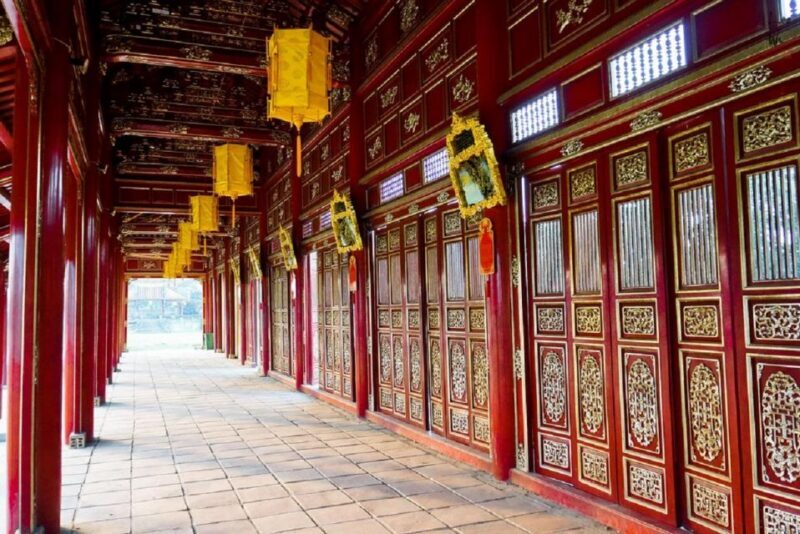
The route can also include Kien Trung Palace, Thai Binh Pavilion, Thieu Phuong Garden, the Royal Theatre and Trieu To Mieu, before ending near Hien Nhon Gate. These stops give you a broader sense of how the citadel functioned, from royal entertainment and gardens to religious and ceremonial spaces.
The Royal Theatre, known as Duyet Thi Duong, is a reminder that court life was not all formal audiences and state ritual. The pavilion and garden stops offer a change of pace from halls and temples, though the allotted visits are short. If your guide is moving the group along, take note of places you want to revisit once the guided portion ends.
At the end of the walk, the guide says goodbye after the Forbidden Purple City section, and you can continue exploring independently. That is a useful arrangement: you get an informed framework first, then freedom to spend more time where your interest is strongest.
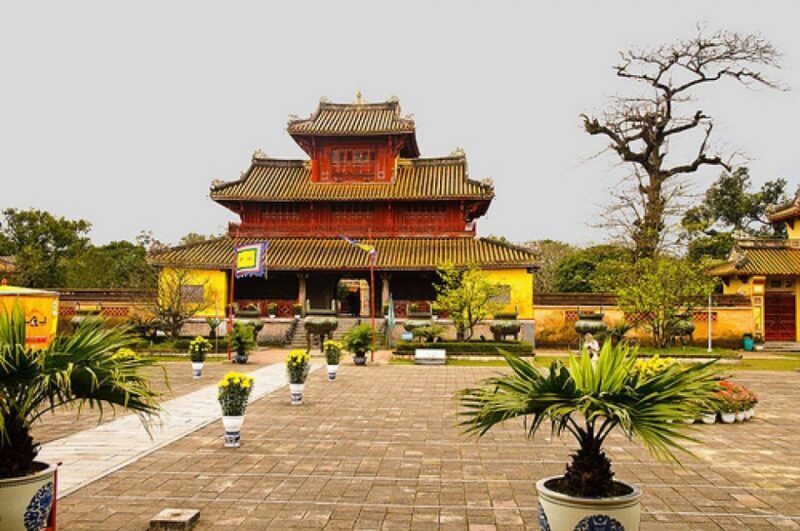
The private-car option can make a full Hue day easier to plan. Thien Mu Pagoda, the Minh Mang Tomb, Tu Duc Tomb and Khai Dinh Tomb are among the listed possibilities, along with the Imperial City and Thuy Tien Abandoned Water Park. You can tailor the selection, but check the exact option details before booking rather than assuming every stop is included.
A car is especially useful if you want to combine the citadel with sites beyond the city centre. It saves you from arranging separate transport for each leg and gives you flexibility over the day’s pace. Still, the driver’s English is for communication, not historical interpretation. If you want a guide to explain the tombs and their architecture, confirm that your selected option includes one. The information provided for the private-car option says it does not.
Pickup and drop-off are included for city-centre hotels in Hue and Hoi An, as well as Hue Railway Station and Phu Bai Airport. There are four stated drop-off areas: Hue, a location identified by the code FH9J+5FH, Hoi An and Da Nang. Because the transfer arrangements depend on the chosen trip, confirm both ends of your journey before departure.
The $12 starting price is attractive for a guided introduction, but it is not the full cost of visiting the Imperial City. Admission is excluded; the stated adult ticket price is 200,000 VND. Combo tickets are listed at 420,000 VND for the Imperial City and two tombs, or 530,000 VND for the Imperial City and three tombs, valid for two days. If you plan to visit tombs as well, compare the combo price with buying separate tickets.
Food and drinks are also not included, though they can be purchased. For the walking option, plan for roughly two and a half hours on foot. The route includes outdoor spaces, and heat or rain can affect your comfort. Guides have adjusted pace and used shade breaks on hot days, but bring what you need for the weather and be ready to walk.
The transport option has a broader price calculation. Its value depends on how many sites you choose to visit and how much you would otherwise spend arranging rides. The high transport rating is reassuring, but it does not replace checking the vehicle option, pickup point and proposed stops for your particular booking.
The most consistently praised part of the experience is the quality of the walking guides. Misa, also named as Minh Sang, has been singled out for warmth, clear explanations and thoughtful discussion of symbolism. Ha, Nhien, Duy, Linh, Nhi and Hoa are among the other guides named for their engaging delivery, strong command of the history and patience with questions.
That matters at a place this large. A guide can connect the buildings to the Nguyen dynasty and Vietnamese royal culture, while pointing out details you could easily pass without noticing. The tone described by visitors ranges from lively and humorous to calm and measured. Some tours have also ended up as private experiences when a group booking had no other participants, but you should not count on having a private guide unless you book that format.
The tour has a 4.9 rating from 937 ratings, and transport has received a perfect score from 94 percent of raters. Those figures suggest a well-liked experience, but the useful distinction remains the same: choose the guided walk for interpretation, or the car for transport and a flexible route.
Book the walking tour if you want the Imperial City to make sense, not just look impressive. It is a strong choice for first-time visitors, families who enjoy historical stories, and anyone curious about the emperors and the workings of the royal household. Go early if you can, especially in warm weather, since the route involves outdoor walking.
Choose the private car if your priority is covering several sites around Hue without arranging each transfer yourself. Just be clear-eyed about the driver’s role and the extra admission costs. If you want both a car and a historical guide, confirm that your chosen option actually provides one.
I would not book solely on the $12 headline price without adding the ticket cost and checking the exact format. But if you choose the option that matches your plans, this is a practical way to see Hue’s most important royal complex with either useful context or flexible transport.
“Ha was a brilliant guide, so knowledgeable and friendly. She explained the history in a very accessible way and made time for us to ask questions a…”
The duration depends on the option selected. The walking tour takes about 150 minutes, while private-car trips can last up to eight hours.
No. Admission is not included. The stated adult ticket price is 200,000 VND.
Meet at the four bronze cannons near Ngan Gate, also called Cua Ngan. The guide holds an A4 paper with your name. There are five cannons on the opposite side, so check you are at the correct group.
No. The guide meets you at the citadel. Pickup and drop-off are included for the private-car option at listed city-centre locations and certain transport hubs.
The private-car option includes an English-speaking driver, not a professional licensed guide. A local guide is included with the walking-tour option.
Possible stops include the Imperial City, Thien Mu Pagoda, Minh Mang Tomb, Tu Duc Tomb, Khai Dinh Tomb and Thuy Tien Abandoned Water Park. The exact route depends on the option you select.
Yes. The activity offers free cancellation up to 24 hours in advance for a full refund, and a reserve-now, pay-later option.
You can check availability for your dates here: