Physical Address
304 North Cardinal St.
Dorchester Center, MA 02124
Physical Address
304 North Cardinal St.
Dorchester Center, MA 02124

See Rome’s Navona, Pantheon, Trevi Fountain and Spanish Steps with a guide, pre-booked access and practical tips on tour options.
Rome’s great centerpieces are close enough to link on foot, but each has a story that can get lost in the crowds. This guided walk connects Piazza Navona, the Pantheon, Trevi Fountain and the Spanish Steps, with the standard option adding entry to the Pantheon and a reserved visit to Trevi’s paid area.
I like two things in particular: you get history along with the famous views, and pre-booked access can make crowded stops easier to manage. One consideration: the pace and time at each site may feel brisk, especially if you want a long, quiet visit inside the Pantheon.
This tour is a useful way to connect several of Rome’s best-known sights in one outing. Rather than moving between them on your own, you follow a guide through the historic center, hearing context at each stop and using personal headsets to catch the commentary in busy places.
The standard route lasts about 2.5 hours, though the activity is also advertised with a duration range of one to 2.5 hours, depending on the option. It begins at one of two possible starting points and finishes at one of two drop-off locations, also depending on your selection. Check the details for your chosen time and version before setting out.
The format suits a first visit, a short stay or a day when you want an overview before exploring on your own. It is a walking tour, not a leisurely sit-down visit at every landmark. Expect to move between stops, listen to the guide, and have some time for photos and questions.
You can check availability for your dates here: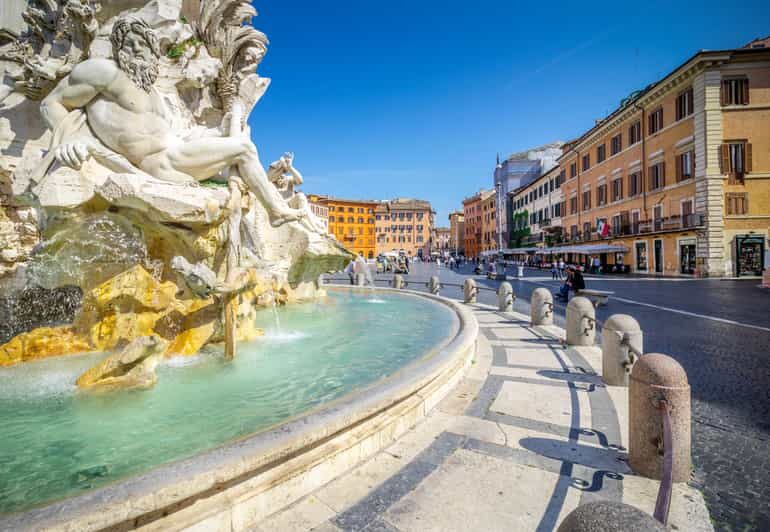
Piazza Navona is the opening stop, and a good place to get your bearings. The square’s centerpiece is Bernini’s Fontana dei Quattro Fiumi, or Fountain of the Four Rivers. Its sculpted figures represent some of the world’s great rivers, and the guide explains the meaning behind the figures and the fountain’s theatrical design.
A guide adds something important here: you can admire a striking fountain without knowing what its sculptures are meant to convey. The tour gives you a framework for looking, so the figures and their gestures become more than decoration. It also places the square in context as a public space with a lively atmosphere.
Expect a guided visit and time for photos, rather than a long stop to sit and watch the square. If you want to return later for a slower look, this is an easy place to put on your own list.
Looking for more options in Rome? Here are some other experiences worth considering.
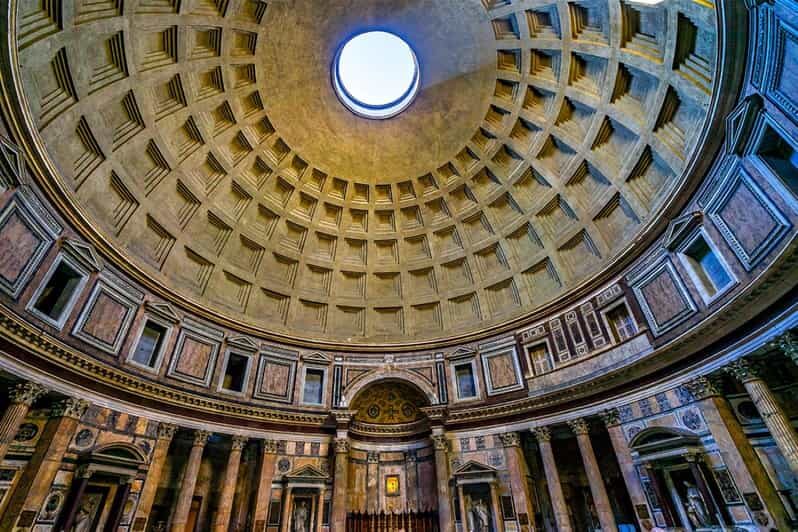
The Pantheon is the most substantial interior visit on the standard tour. With a pre-booked entrance ticket, you go inside to see the great dome and its oculus, an opening at the top that brings daylight into the building. The dome is the world’s largest unreinforced concrete dome, an extraordinary feat of Roman engineering.
The guide’s explanation helps connect the building’s original role as a temple to all gods with its later life as a church. That change is part of why the Pantheon has carried so much meaning across centuries. Instead of treating it as a quick photo stop, the tour uses the interior to explain the layers of Roman history and architecture.
This is also where expectations matter. You will get a guided introduction, but the tour’s fixed schedule may not leave as much time as you would choose for close, unhurried inspection. If the Pantheon is your main priority, consider the separate Pantheon Only Full Immersion option. It focuses on the building and includes a peek at Santa Maria Sopra Minerva.
Dress rules apply inside: cover your shoulders, and avoid short shorts or skirts, low-cut clothing and sheer garments. These are easy details to plan for, and they can save trouble at the entrance.
After the Pantheon, the route pauses at Piazza di Pietra for an exterior visit to the Temple of Hadrian. Its imposing columns are a reminder that ancient Roman structures are woven into the modern city, sometimes in places where you might otherwise walk straight past.
This is a short stop, not an interior tour. The guide explains the temple’s connection to Emperor Hadrian and its place in imperial Rome. I like this kind of pause on a walking route because it breaks up the sequence of headline sights and gives you another way to read the city’s layers.
The main value here is interpretation. You will see the columns from outside, hear their story and continue on. If you are expecting a long archaeological visit, adjust that expectation: the stop is brief by design.

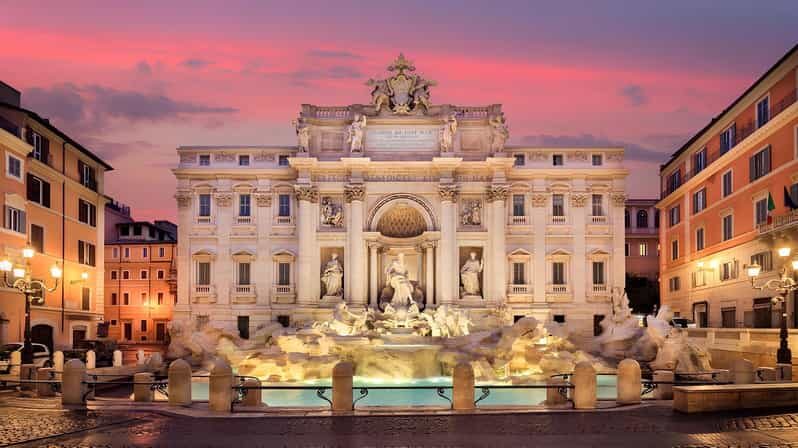
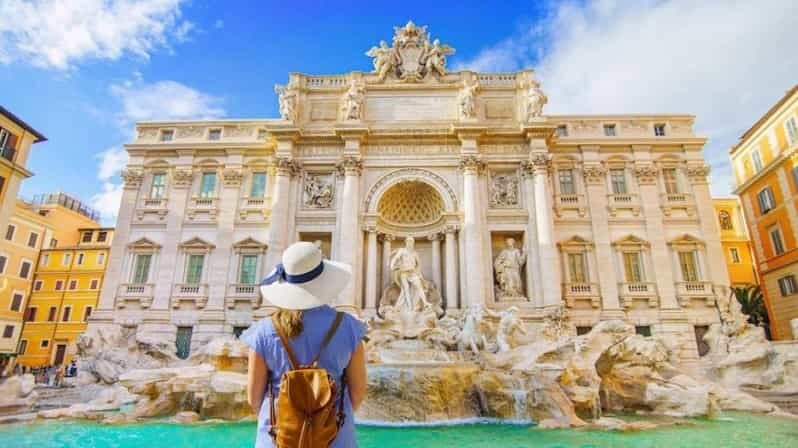
Trevi Fountain is the route’s most theatrical stop. Its Baroque design centers on Neptune in a chariot drawn by sea creatures, with water spilling across the sculpted scene. Your guide explains the fountain’s imagery and its connection to the work of Nicola Salvi.
On the standard tour, a pre-booked ticket gives you access to the fountain’s paid area, bringing you closer to the water and sculptures. That can be useful when the area is crowded, and the tour information describes access through a separate entrance. It does not mean the site will be empty, so keep your expectations realistic and follow the guide’s directions.
After the guided explanation, you have free time to toss a coin and take photos. The coin toss is a small ritual, but it gives you a moment to enjoy the fountain at your own pace before moving on. If you want to linger, make the most of this pause; the route continues to the Spanish Steps.
There is an important difference between tour versions. The sunset option visits Trevi from outside and does not include the paid-area ticket. If close access is a priority, choose the standard tour rather than assuming every version includes the same entry.
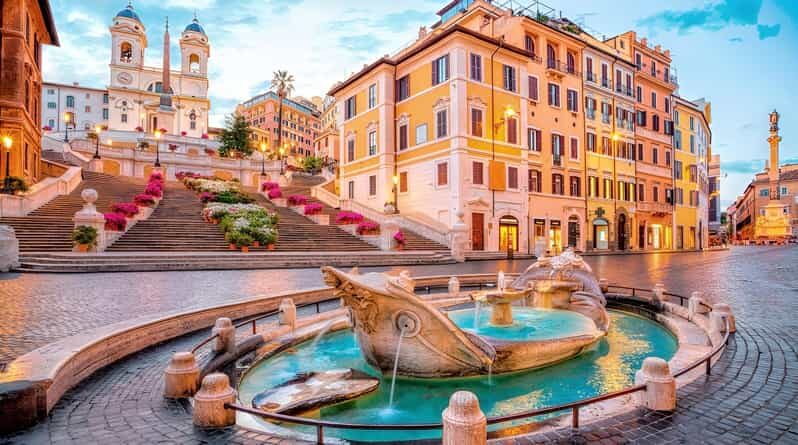
More Great Tours NearbyThe walk concludes at Piazza di Spagna and the Spanish Steps, the broad staircase known in Italian as the Scalinata di Trinità dei Monti. The guide covers the piazza’s social history, including the area’s association with Keats’ house and high fashion.
At the base of the steps, look for Bernini’s Fontana della Barcaccia, shaped like a sinking boat. The tour gives you a chance to hear the story behind this fountain too, then climb the steps for a view across the piazza and surrounding streets.
The finish works well because it leaves you in a place where you can continue exploring after the guide wraps up. The sunset version is especially designed around this ending: it concludes at Trinità dei Monti, where you can enjoy the late-day view. That option gives up the Pantheon interior and Trevi’s paid-area access, so weigh the cooler evening atmosphere against those omissions.
The guide is central to the value of this tour. You are not just being led from one photo stop to another; you are getting an explanation of Bernini’s fountains, Roman architecture, the Pantheon’s changing role and the social history around the Spanish Steps. The tour runs in English, Italian, Spanish and French, and personal headsets help you hear the guide without needing to crowd close.
Guides named in visitor comments include Cristina, Lisa, Priscilla, Davide, Roberta, Gaga and Jeanette. Names and guide assignments vary, of course, but the most praised qualities are clear explanations, a friendly sense of humor, patience with questions and the ability to move a group through busy streets. Some guides add local perspective, practical suggestions or small details that are easy to miss on your own.
The pace is not guaranteed to suit everyone. Many people describe a comfortable rhythm, while one visitor found the walk too fast and another wanted more time inside the Pantheon. If you prefer long stretches to explore each site independently, this guided format may feel compressed. If you like a steady route with a guide handling the history and navigation, the pace is more likely to work for you.
Crowds, heat and occasional closures can affect a central Rome walk. Guides have been praised for finding their way through busy areas and adapting when conditions change, but no tour can promise quiet streets or a fixed view at every stop. A late-day departure may be more comfortable in summer; the sunset version is specifically offered as a cooler, scenic alternative, with a different set of site access.
At $32 per person, the tour can be good value if you plan to visit these sights anyway and want a guide to explain them. The standard option bundles a walking tour with pre-booked Pantheon entry and access to Trevi’s paid area, plus audio headsets. Those inclusions matter most when you value guided context and want help managing the busy central sights.
The price is less compelling if you prefer to move at your own pace, skip guided commentary or spend a long time inside the Pantheon. Food, drinks and transport to the meeting point are not included, so allow for those separately. The sunset version also has a different value calculation: you trade the Pantheon interior and paid Trevi access for a later walk and a sunset view from Trinità dei Monti.
You can reserve now and pay later, and cancellation is available up to 24 hours in advance for a full refund. Private groups are also available. Those options help if your plans are still taking shape or if you would rather tour with your own party.
I would choose the standard tour if this is your first time in Rome, you want a compact introduction to the historic center, or you place a high value on entering the Pantheon with a guide. It also suits people who want to understand the symbolism behind the fountains instead of treating them as quick photo stops.
Choose the sunset version if cooler late-day conditions and the view from Trinità dei Monti matter more than going inside the Pantheon or entering Trevi’s paid area. For a focused Pantheon visit, the Pantheon Only Full Immersion option is the better match.
This activity is not suitable for wheelchair users. Baby strollers, luggage and large bags are not allowed, and weapons or sharp objects, alcohol and drugs are prohibited. Wear comfortable shoes, bring a camera, and check the meeting details for your selected option.
Book this tour if you want a guided introduction to Rome’s central landmarks and value the standard option’s Pantheon entry and closer access at Trevi. The route offers more than a checklist: a good guide can make Bernini’s sculptures, the Pantheon’s dome and the city’s changing layers easier to understand.
Skip it if you want a slow, self-directed visit with plenty of time at every stop. And choose carefully between the standard and sunset versions: one prioritizes access inside, the other ends with an evening view. That distinction is the key to booking the right tour.
“Our guide was Christina. She was very knowledgeable about all the places we visited. The pace was just right, not too fast but we were able to see …”
The tour is described as lasting about 2.5 hours, though the activity duration range is one to 2.5 hours depending on the option.
The route includes Piazza Navona, the Pantheon, the Temple of Hadrian, Trevi Fountain and the Spanish Steps.
Yes. The standard option includes a pre-booked Pantheon entrance ticket. The sunset option visits the Pantheon from outside.
No. The standard option includes pre-booked access to the paid area. The sunset version visits the fountain from outside without that ticket.
Live guides are offered in English, Italian, Spanish and French.
Yes, a private group is available.
Your shoulders must be covered. Short shorts or skirts, excessively low-cut clothing and sheer clothing are not permitted.
No. The tour is listed as not suitable for wheelchair users.
Yes. You can reserve now and pay later, and you can cancel up to 24 hours in advance for a full refund.
You can check availability for your dates here: