Physical Address
304 North Cardinal St.
Dorchester Center, MA 02124
Physical Address
304 North Cardinal St.
Dorchester Center, MA 02124

Read Budapest through its streets on this two-hour storyteller walk, from the Danube’s divided cities to Parliament and the Shoes memorial.
Budapest’s grand buildings make more sense when you know what they are arguing about. On this two-hour walk, a local guide links the city’s split past, political symbols and riverfront scars to the streets in front of you, ending at Parliament with a better eye for what its scale and design mean.
I like two things in particular: the guide treats architecture as a record of power, not just a pretty backdrop, and the route makes room for both the lively stories around Gerbeaud and the quiet pause at the Shoes on the Danube Bank. Guides such as Gary, Dora, Sofia, Rita and Esther have led tours, with humor, clear explanations and practical tips often part of the experience.
One consideration: this is an outdoor walk, rain or shine, and the pace can feel brisk, especially in a large group. You do not go inside any buildings, and the minimum group size is four, so check the confirmed meeting details and dress for the weather.
The tour begins at Erzsébet Square, where your guide asks you to take in both sides of the street. It is a simple exercise, but it introduces the walk’s central idea: Budapest is not one uniform place. Its character was shaped by the relationship between Buda and Pest, towns that remained separate until 1873.
The Danube is more than a scenic divider here. It helped shape how the two sides developed, and the tour asks you to notice the contrast even in a city now joined by bridges and shared civic life. One side can feel ordered and imperial; the other carries a different, older character. Your guide gives you a way to notice that distinction rather than simply memorizing dates.
This opening is especially useful if Budapest is new to you. A short historical framework helps the later stops connect, and you can carry that perspective into the rest of your stay. Several guides also offer suggestions for food, transport and other sights, so it is worth asking questions as you walk.
If you enjoy exploring Budapest on foot, these walking tours might also suit your style
At St. Stephen’s Basilica, the group stays outside and looks closely at the facade. Your guide explains how the figures are arranged and what their position in the stonework is meant to convey. Instead of treating the church as a quick photo stop, you learn how to look at it as a public statement.
The bells are part of the experience too. The tour makes space to listen to them roll across the square at the hour, turning a familiar city sound into something to notice. The guide also connects the basilica to Hungarian football through a story that may seem unlikely at first. The point is not to collect another odd fact, but to see how stories can link national identity, public places and everyday interests.
There is no entrance fee because the tour does not go inside the basilica. That keeps the walk moving and avoids the extra time and cost of an interior visit, but it also means this is not a substitute for seeing the church’s interior. If that matters to you, plan a separate visit.
Outside Gerbeaud, the tour turns to Budapest’s coffeehouse culture. The cafe’s coffee and pastry are part of its present-day appeal, but the guide’s focus is on what places like this meant to the city. Coffeehouses served as workspaces for writers and gathering places for people who wanted to talk politics and public affairs.
That context changes what you see when you pass the door. A grand café becomes a clue to how people worked, exchanged ideas and built social networks. The tour does not include food or drinks, so you are not stopping for a tasting. If you want to try the cafe afterward, you can return on your own, with the story fresh in your mind.
This is one of the walk’s more useful shifts in scale. Budapest’s history can seem enormous when it is told in terms of empires and political change. A coffeehouse offers a more personal route into that past: imagine the conversations that took place in rooms like these, and the people who relied on them as offices or meeting halls.
Along the Danube Promenade, the guide asks you to notice different periods in the buildings and streetfront. The riverbank is presented as a kind of visual record, with elegant older details, Soviet-era replacements and postwar rebuilding sitting beside one another. Some repairs, the tour suggests, do not quite hide what came before.
The walk’s description points to Budapest being badly damaged and rebuilt twice within thirty years. Here, the city’s past is not only a set of dates; it is visible in what remains, what was replaced and what reconstruction could not fully restore. The river gives you a long view of those changes, while the facades provide the smaller clues.
This stop rewards attention more than speed. If you are used to scanning a riverfront for the best photo angle, try looking at the buildings as well. A guide can help you distinguish the different layers, though the experience depends on being able to hear and see clearly in a group. Large groups may be divided between guides, and some guides use a microphone and speaker to make themselves easier to hear.
More Great Tours NearbyAt the Shoes on the Danube Bank, the tour narrows its focus to one person, one night and one pair of shoes left at the river. The guide tells the story, and the group pauses at a memorial that asks for stillness rather than a long explanation.
It is a powerful change of pace after the architecture and citywide history. The memorial gives the riverbank a human scale, and the absence of a grand building or elaborate display makes the stop feel especially direct. You may find it hard to put the moment into words afterward; give yourself a little time to take it in.
The walk does not enter buildings, but this outdoor stop shows how much an outdoor tour can hold. You do not need a ticket or a queue to encounter a serious part of the city’s memory. You do need to be prepared for a group setting, where the guide is balancing the moment for everyone.
If you prefer having a local expert, these guided Budapest experiences could work well
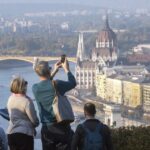
The route ends at the Hungarian Parliament, where the guide returns to the idea of reading buildings. The structure took seventeen years to build and was completed as the empire that financed it began to decline. Its dome is the same height as that of St. Stephen’s Basilica, a deliberate result of negotiation rather than coincidence.
Those details make Parliament more than a grand finale for photos. Its scale and proportions speak to political choices and national ambition, while its timing ties it to a period of major change. By this point in the tour, you have already practiced looking for meaning in facades, symbols and layers of rebuilding. Parliament becomes a final exercise in applying that habit.
The tour ends outside, so you will not see the interior or secure entry as part of the walk. A guide may offer ideas for what to do next, and a free public restroom is available at the endpoint. If you hope to tour Parliament inside, arrange that separately rather than assuming this walk includes it.
The listed price is $2.69 per person, which is low for a guided two-hour introduction to several central sights. The value comes from the explanations and the route, not from admission tickets, food or transport: the walk is entirely outdoors, and none of those extras are included. The guide’s gratuity is also excluded. If you plan to tip, bring cash.
The low listed price can be confusing because some people think of this style of walk as free, with payment mainly offered to the guide afterward. Here, a booking price is shown, while gratuity remains separate. Check the amount and payment terms when booking, and decide in advance what you want to spend overall.
Two hours is long enough to establish a useful overview without taking over your day. The route is described as a comfortable walking pace and suitable for most fitness levels, but one guide’s pace was called fast. If you prefer frequent stops or walk slowly, mention that to your guide where possible and allow for the fact that group pace is shared.
The group must have at least four participants for the tour to operate. Groups of eight or more need to contact the provider at least 24 hours in advance, whether booked together or separately. Larger groups may be split between guides, which can help keep the experience manageable, though the exact group size can vary.
I would book this early in a Budapest stay. The tour gives first-time visitors a framework for understanding the city, and guides often share useful local suggestions for restaurants, shopping and other places to see. Those tips are more valuable when you still have time to use them.
It also suits anyone who likes history best when it is tied to what they can see. Instead of spending two hours inside a museum, you move through public squares and along the river, learning to read churches, cafes, memorials and government buildings. The storytelling is central, so this is a better fit if you enjoy listening and asking questions than if you want a self-guided walk with long stretches of quiet.
The route is wheelchair accessible, but it remains an outdoor walking tour. Bring comfortable shoes and clothes, plus a camera if you want one, and dress for the forecast because the tour runs in rain or shine. Meeting-point details are confirmed in your voucher, so check it before setting out.
Book this tour if you want a strong first look at central Budapest, especially if local stories help you remember a city better than a list of dates. The two-hour route combines major sights with context, and the stop at the Shoes memorial gives the walk a thoughtful balance.
Skip it if you want to enter Parliament or the basilica, sample food as part of the tour, or explore at your own pace. Those are not included. For an inexpensive outdoor introduction led by a local storyteller, though, this walk offers a practical way to start seeing Budapest as a city with layers, arguments and memories written into its streets.
“Fabulous tour of Budapest! Loved our guide and all we saw and learned about this beautiful city.”
The walking tour lasts two hours.
It begins at Erzsébet Square. Your meeting-point details will be confirmed in your voucher.
It ends outside the Parliament building. A free public restroom is available at the endpoint.
The tour is offered in English.
No. It is entirely outdoors, with no building entrances or entrance fees included.
No. Food and drinks are not included.
Yes, the activity is listed as wheelchair accessible.
Wear comfortable shoes and comfortable clothes, and bring a camera if you wish. Dress for the weather because the tour operates rain or shine.
Yes. At least four participants are required for the tour to operate. If that minimum is not reached, you will receive a full refund.
Groups of eight or more must contact the provider at least 24 hours in advance, whether the participants booked together or separately.
You can check availability for your dates here: